Home›Strategy Activation & Change
Strategy Activation & Change
Strategy becomes effective
when leadership turns it into
coordinated action.
We know our strategic goals. We just aren’t getting them executed!
MLI helps leadership teams make strategy tangible and real in its execution. Those involved understand the context and their own contribution, and deliver concrete results across boundaries.
Strategy development and activation are one single process — from the target picture in the leadership team to the moments that decide success in daily work, including support for major change initiatives.
The situation
Six reasons strategy execution stalls.
None of them appears in the strategy paper, and none can be solved with more paper. For a strategy to be lived successfully, it has to activate heads and hearts.
01 · Diagnosis
The real problem goes unnamed
People formulate fine-sounding goals that do not connect to reality. Everyone senses the contradiction, but no one says it out loud.
02 · Identification
Strategy fails on plain misunderstandings
What is missing is a guiding picture that makes the context understandable and from which people can derive their contribution. 60% of managers cannot coherently explain their own company’s strategy.1
03 · Attention
Urgent beats strategically important
Communicated is not yet understood. Anyone who has ever tried to lose weight or exercise more knows this. You need a clear structure and a system that reminds you, again and again, to stay the course.
04 · Methodology
New Work has produced a multitude of tools and methods
The attention they absorb is lost to the substantive work of serving customers. Without a shared methodology, people often argue about the approach before concrete results even come into view.
05 · Speed
Organized helplessness: willing, but not permitted
Roles are unclear, decision paths long and opaque. What could be settled in a week paralyzes an initiative for months. Transparency and orchestration are missing.
06 · Coordination
Too many committees, too little accountability
Value is mostly created across functional boundaries. Cross-functional collaboration needs a leadership system of its own, one that actually works, to execute strategy.
Strategy activation is the craft of aligning all the levers that lead to results-oriented collaboration at the tactical level.
1 Survey of more than 2,000 middle managers, StepStone.
Our thesis
The bottleneck is not the wording. It is the minds.
This is what we believe. If you disagree, we are probably not the right partner.
Strategy must keep execution in view
A strategy that cannot be made concrete is empty. Anyone who talks about “mindset” invites suspicion. New value for customers and stakeholders always comes with new actions. Leadership has to translate the strategy into the moments of truth in everyday work.
Execution fails for lack of attention and time
Even a sound strategy rarely fails on content; it fails for lack of focus and under operational overload. Unclear roles and structures paralyze the attention of key people who are fully booked already.
Impact comes from a shared leadership rhythm
What decides is not the perfectly worded strategy but a fast-learning system through which it is executed. That system has to be transparent, activating, results-oriented and iterative.
What we do
We think from the strategic opportunity all the way to concrete results.
Cross-functional collaboration has to hold its own against the operational undertow. We help decision-makers establish an effective system for executing strategy — without bureaucracy. Time is money; structure is the foundation of every successful change. What helps is an outside view and a position no one inside the company can hold: a neutral one.
A strategy meant to move something always changes work, too. It must therefore address, from the very beginning, the possible objections of the people needed to execute it. Strategy activation is always a change initiative as well. Without a coalition of willing, competent key people, success is hard to achieve. We help turn that group into a strong team.
- Strategy Health CheckWe review what exists. Above all, we are interested in what actually lands in people’s minds. We talk to the key people and make transparent where there is agreement and where the greatest contradictions lie. The “yes, but …” responses are the most valuable findings for executing a strategy successfully.
- Leadership CoalitionWho are the key people needed to execute the strategy successfully? We help make a strong team of them. Different perspectives jointly develop a target picture of what success looks like once the strategy has been executed. In a facilitated process, you find ways to overcome existing hurdles.
- ActivationThrough the Leadership Coalition, many employees are involved in understanding the target picture and giving feedback on it. They clarify and practice the new actions expected of them. MLI contributes the most effective formats and methods so that the strategy is seen and judged positively.
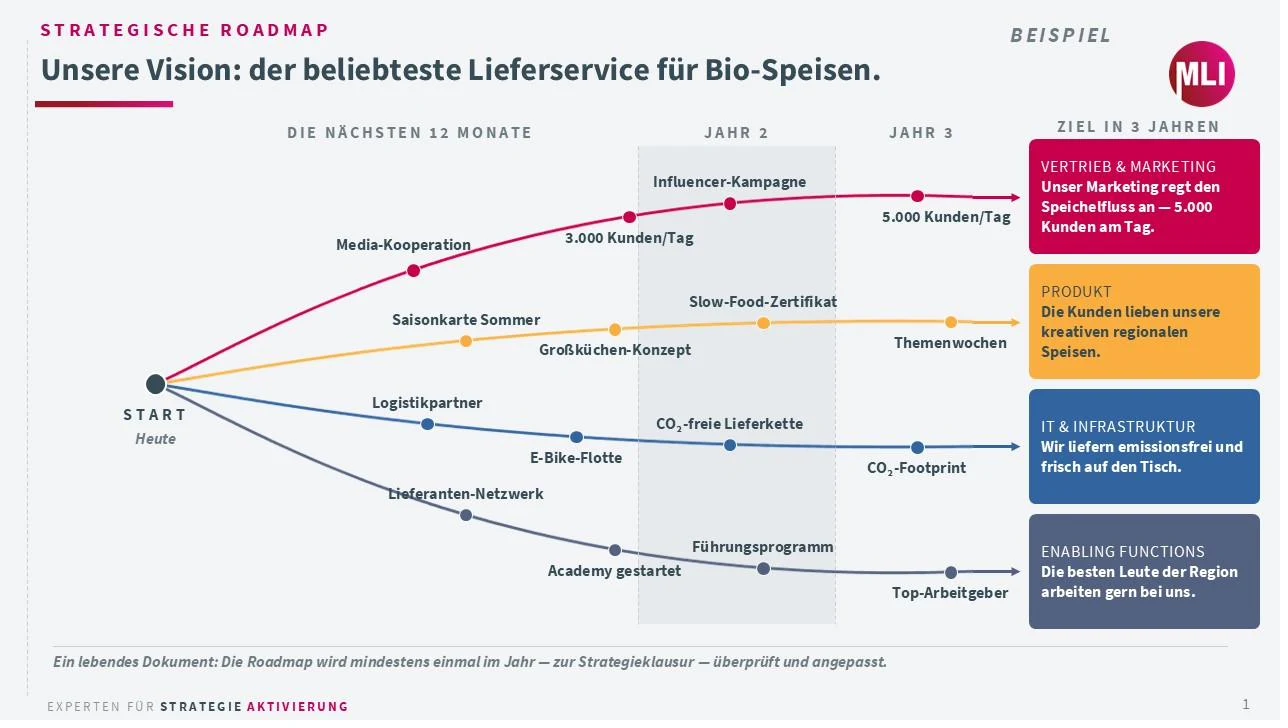
- RoadmapNo route, no journey. A roadmap demands coordination across units, prioritization and a willingness to compromise. MLI facilitates as a neutral partner. At the end there is clarity about the concrete milestones of the next twelve months and the interim goals of the next three years — updated on a rolling basis.
- Strategy sprintsA shared rhythm bundles attention and ensures consistency. Sprint planning every three months. Top management sets a few priorities; capable, autonomous mission-driven teams deliver measurable results. MLI provides the methodology. More ownership, more time for real execution work, more discipline. Not an additional committee, but the replacement for many uncoordinated steering groups. Behavior changes through repetition, not through declarations of intent.
- Enabling internal OKR mastersTwo to four people from your organization are trained to run the rhythm themselves. From the third sprint on, they facilitate; we only accompany. The goal of the mandate is that you no longer need us. Self-reliance is our standard.
Working with MLI helps us pool our strengths as a team and set the right priorities.
The past 18 months have been an exciting journey with you, and I have learned a great deal. We achieved a lot together: developing the strategic roadmap, drafting the guiding vision and many stimulating discussions at the offsites. Thank you for your sparring and for the exchange. You are a great team!
We received strategic input, but we also saw very concrete examples of the intelligent use of AI. By the end, our management team had a shared picture of how to use AI, prioritized use cases and a clear plan to embed and execute the topic systematically.
Key people
The people it cannot work without, and who are rarely all in the room.
Who gets invited to strategy work is usually decided by the org chart. That is the most common design flaw. Three roles are needed, and only one of them appears on the org chart.
Line managers
Those who decide on capacity. Without them there are no resources and no commitment. They are almost always invited. But without the others, they often cannot penetrate the complexity.
Forward thinkers
Those who see the opportunity earlier. People close to the market, with technical foresight or unusual questions. They rarely carry leadership responsibility and are therefore overlooked — yet without them no option emerges that goes beyond what already exists.
Implementers
Those who actually get it running. The few on whom, in our experience, every initiative depends. They are in demand everywhere and therefore chronically overbooked. Anyone who does not relieve them of other tasks squanders their energy and effectiveness.
Why choosing the key people is decisive
Strategy work is a complex task. It needs a group that thinks from the market all the way to execution, and is willing to keep learning from month to month. That is why we do not select key people by hierarchy but by strategic judgment and ability to execute. Good line managers are not always good strategists, and good strategists are not always effective implementers — all three are needed.
How we identify them
- We ask: whom do you really need to turn the strategic initiative into lasting success?
- Comparison of the names given with the org chart — the deviation is the finding
- A check of actual capacity: who is named and fully booked at the same time?
- A breathing system: each phase needs different strengths. Binding release from other duties for the scope of the sprint, decided by top management
Without the last point, the rest has no consequence. A nomination without relief is simply an extra task.
The mechanics
How a strategy sprint works.
The rhythm is the actual product. It synchronizes the attention of people who are pulled in different directions every day.
-
Goal planningBased on the strategic target picture, the roadmap and the results to date, top management decides on a few priorities — not on measures. In a one-day workshop, the key people plan the concrete target results across units and assign owners and capacity.1 day
-
ExecutionCapable teams get as much time as possible to design and deliver measurable results — instead of being paralyzed by reporting and internal coordination.3–4 months
-
Check-inSixty minutes a month per team. Not a status report, but an anticipatory look at what is stuck and needs attention.monthly
-
Review and retrospectiveThe teams show their most important stakeholders concrete results, not presentations. Anyone with nothing to show says so — that, too, is a result. Afterwards comes the one hour in which the conversation turns to the how rather than the what.end of sprint
After three sprints, your organization runs the rhythm itself. We then join only the goal planning, and from the fifth sprint on not at all.


Enlarge ↗
Enlarge ↗What you have at the end
Six results that stay in-house.
No presentation that disappears into a shared drive. Tools and methods your leaders go on using without us.
- A strategy diagnosis with the goal conflicts named
- Each unit’s contribution, in writing and known to all
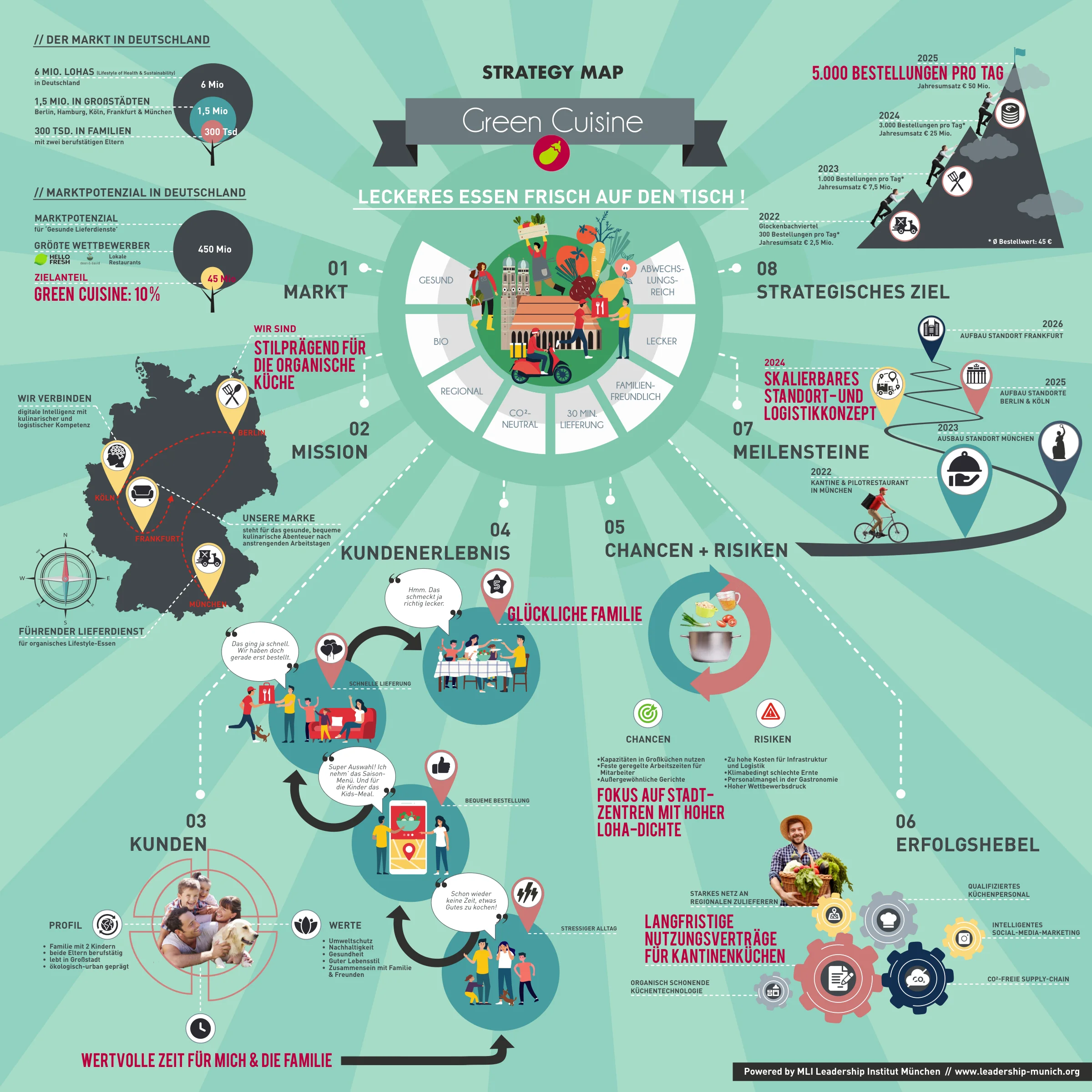
- The strategic guiding picture as a narrative and as a one-page strategy map
- The structure of a 24-month roadmap with owners, updated on a rolling basis
- The sprint rhythm as an established calendar routine, including a playbook
- Two to four trained OKR masters from your own organization
Effort and scope
- Duration
- 9 to 18 months until handover
- Participants
- Top management plus 10 to 30 key people
- Leadership time required
- About 4 days per quarter, 2 of them in the sprint rhythm
- Entry point
- Review and survey, 4 to 6 weeks, can be commissioned separately
- Fees
- Fixed fees for defined deliverables, commissioned phase by phase. No daily rates.
The evidence
What has measurably changed.
Real project examples.
How it was measured. Standardized survey of all participants before the start and after fifteen months, n = 3,500, same version of the questionnaire at both points in time. The scores for trust and engagement come from the same survey at a leading insurance company. Time to market denotes the time from requirement to the availability of strategically relevant functions at a software company, measured via the product dashboard.
Case 01
Building a group-wide People & Organization function
- Starting point
- A newly appointed group board member was to strengthen the HR function strategically.
- Approach
- Future scouting, interviews with key people, development of strategic goals and options in workshops, elaboration of vision, target picture and roadmap. Strategy sprints with 30 key people.
- Result
- After six months, 80% of leaders rated cross-functional collaboration as clearly better. After six months the board adopted the strategy; after nine months the first strategic result was in place. Unexpected crises, too, were handled through the rhythm.
Case 02
Scale-up in the software industry
- Starting point
- A growth plan agreed with the investors: plus 20% earnings growth per year.
- Approach
- Execution of the strategic plan through a leadership system with quarterly strategy sprints based on OKR.
- Result
- Execution in spite of crises — from the pandemic to the leap in AI development. The AI trend was recognized in time, an overly rapid build-up of staff was halted, productivity rose and the growth plan was met.
Case 03
Telecommunications group after a merger
- Starting point
- Two companies, two leadership cultures, one shared mandate.
- Approach
- Comparison of leadership styles, an activating mission and roadmap, clarification of each team’s contribution by every leader, activation workshops run by the leaders themselves.
- Result
- Employees’ understanding of the strategy up 56% within three months.
Who it is for
We do not work with everyone.
Strategy activation pays off above a certain size and in a certain situation. We would rather say so up front.
A good fit
- Large and mid-sized companies and organizations with more than 30 leaders
- In a phase of growth or transformation where the direction is right but the pace is not
- Value is created largely through knowledge and intellectual work
- A top management team that takes part in the process itself rather than delegating it
- A willingness to actually cut priorities instead of adding to them
Less of a fit
- Smaller companies steered by direct word of mouth — team coaching is usually the better choice there
- Companies looking for an external partner to write down what they should do
- Initiatives in which the leadership level is at odds on a personal level — there, mediation comes before strategy (see Coaching & Sparring)
- Organizations with a planning horizon of less than twelve months, for example in acute restructuring
The next step
The entry point is a conversation, not a proposal.
45 minutes of getting to know each other and sparring with Sebastian Morgner. We sort out your situation and name the central lever, even if MLI is not the right partner for it.
45 minutes
Personal conversation
A first meeting, an exchange about your needs, not a sales pitch. Choose a time directly in the calendar, with no intermediate step and at no cost.
Choose a timeFive fields
Contact by e-mail
Describe your topic briefly: one or two sentences are enough. We reply within two business days.
Prefer to talk? +49 8807 244446-0
PDF · 21 pages
Institute dossier
Methodology, survey instrument, reference architectures, fee models and network profiles — for forwarding internally when an initiative still needs to be justified.
Download the dossierQuestions and answers
What decision-makers ask us most often.
Short answers to the questions that come before every engagement. In more depth, gladly, in conversation.
What is strategy activation?
Strategy activation is a change process rooted in group dynamics. An organization’s key people are enabled and motivated to actually execute a strategic initiative. It differs from strategy consulting in that the focus is not on the content of the strategy but on the conditions for executing it: focused attention, aligned thinking, available capacity and a shared rhythm.
How does it differ from classic strategy consulting?
A strategy consultancy delivers an answer. We build the mechanism with which your own leadership develops and implements the answer. That is why we do not write a strategy but examine the existing one, facilitate its concretization and introduce a rhythm of execution. At the end there is no report, but an accepted target picture, a concrete roadmap and a working execution mechanism with trained multipliers from your own organization.
Which steps decide strategy activation and change?
Six: the diagnosis of the existing strategy, making it concrete for every unit, a guiding picture from which a personal contribution can be derived, a roadmap with a binding near-term horizon, an execution rhythm in sprints of 3–4 months, and the enablement of internal facilitators. The last step determines whether the impact remains after we leave.
Why does a guiding picture matter?
A guiding picture answers, for every employee, why a strategic initiative matters and which attitudes and behaviors it takes to succeed. It gives orientation about the contribution each person makes to overall success. Without that derivation, there is no identification, at best agreement. It also serves as a decision aid in the situations where one’s own behavior makes a difference, and thus enables new routines and the build-up of the right capabilities.
How are employees involved in strategy activation and change?
What employees perceive is decisive. Objections and concerns in particular have to be voiced openly and evaluated for activation to work. They are gathered in dialogue formats and structured interviews with selected key people, not in mass surveys. Whoever is expected to implement something later must have been heard beforehand — the success rate of strategic initiatives rises measurably when the people implementing them took part in developing them. The prerequisite is an atmosphere in which dissent has no consequences.
What role does leadership play in strategy activation and change?
The decisive one. Leadership is the capability that carries strategic goals into execution, the positive force of change. It sets the direction, frees up capacity, involves key people and tells the story about the future of the company itself, not through a consultant or service provider. Where a management team delegates this work, activation fails reliably. That is why we only work with leadership teams that take part themselves.
How do you measure the success of strategy activation and change?
What matters is defining the criteria for success before an activation program begins. They have to be measurable during implementation. That can be the measured perception of those involved regarding understanding, motivation, capability and effectiveness, collected on Likert scales. It can also be the average time from concept to delivery of particular results, or the number of key results successfully achieved.
For larger programs, a standardized survey before the start and after 12–15 months is worthwhile, using the same version of the questionnaire. Among relevant stakeholders it covers, among other things, understanding of the strategy, trust in leadership and engagement. In one documented case, the score for leadership effectiveness rose from 36 to 73 points among 3,500 respondents. We disclose the survey instrument before the contract is signed.
How long does it take, and what does it cost?
Nine to eighteen months until handover, beginning with a review of four to six weeks that can be commissioned separately. We work with fixed project fees for defined deliverables rather than daily rates, and each phase can be commissioned on its own. The time required of your leadership is about four days per quarter.
More of what we offer
AI Transformation
When everyone talks about AI and everyone does their own thing
Setting the course, building capability and a framework that makes impact measurable.
Coaching
When it depends on individual people
Support for board members, managing directors and key people, individually or as a contingent.
Leadership Development
When the leadership level as a whole needs to grow stronger
Programs for entire leadership populations, 6–18 months, embedded in the work.